
Cycles IQ Membership · By invitation
The full cycles stack, with the person who built it.
The Cycles IQ Membership is the full way into Cycles IQ, by invitation. It gives you Lars's lenses and cycle scoring dashboards, the Cycles IQ API and MCP, the advanced analyzer and the scanner pages, the Cycles AI skills with pre-built applications and dashboards, the Cycles Knowledge Graph as it is built, and ongoing sessions with Lars von Thienen. It starts with one request.
What membership includes
One membership, the whole stack.
- Full Cycles IQ API and MCP access, from your code or from Claude, ChatGPT and Cursor.
- The lenses and cycle scoring dashboards: Lars's own interpretation of the cycles, available only to members.
- The Cycles AI skills: the method, the endpoints and the documented pitfalls, packaged for your AI coding tool.
- The advanced cycle analyzer and the scanner pages, with extended tools and screens.
- Pre-built applications and dashboards as starting points for your own screens.
- The weekly cycle readings of the research newsletter.
- Updates, maintenance and support for Lars's tools.
- A 2-hour onboarding session with Lars, with a written recap.
- 30-minute sessions with Lars during the membership, booked about a week ahead.
- The Cycles Knowledge Graph, stage by stage: Findings Report 01 first, then the graph tools for MCP and API, then the lenses and the agent.
- Chart interpretation: a dedicated Cycles language model reads your cycle analysis charts and returns a written interpretation, in the dashboards, through the API and as a lens of the Knowledge Graph.
- Where agreed in your offer: the stack on your own infrastructure.
Who it is for
Three ways to work with the same engine.
Read the cycles, no code needed
Lars's lenses and scoring dashboards, the advanced analyzer and the scanner pages, with sessions to check your reading with the author of the method. None of them needs code.
The engine inside your own process
By API, under NDA, and on your own infrastructure where agreed in your offer. Applications you build and results you generate belong to you.
Describe the screen, let the AI build it
The Cycles IQ API, MCP and the Cycles AI skills: your AI coding tool builds scanners, dashboards and pipelines on the model.
FSC members already use the engine in the FSC cycles app. The membership adds the lenses and scoring dashboards, the advanced analyzer, full API and MCP access, the Cycles AI skills, the Knowledge Graph and sessions with Lars.
How membership works
Five steps from request to onboarding.
- Request an introduction. A short form: who you are and what you want to measure or build.
- Questionnaire. Six questions at your personal link, about five minutes.
- Intro call. Thirty minutes with Lars on Microsoft Teams. Once it is booked, you can use the API and the MCP server with a free Cycles IQ account.
- Offer and NDA. Your individual offer and the non-disclosure agreement follow by e-mail within a few days.
- Setup and onboarding. Repository invite, API key, MCP and analyzer access, then the 2-hour session.
- A one-time joining fee and an annual service and update fee, stated in your offer.
- An initial term of twelve months, then yearly renewal; the Terms set out the notice periods.
- Nothing is billed before you accept your offer.
- Applications you build and results you generate belong to you.
- Breaking API changes are announced at least sixty days ahead, security fixes excepted.
- Results are measurements and projections, not investment advice.
Full text: Terms of Service.
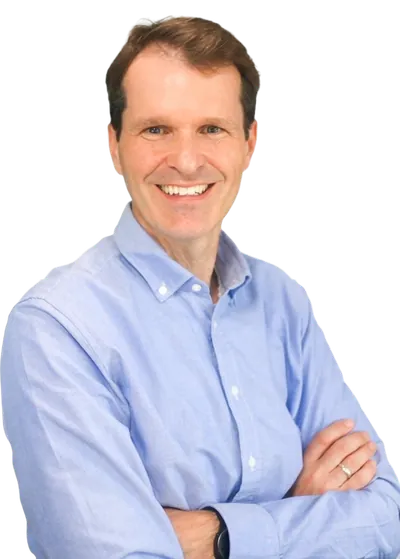
Who you work with
Lars von Thienen
Lars von Thienen has built the cycle engine behind Cycles IQ over twenty-five years. He wrote Decoding the Hidden Market Rhythm (Part 1: Dynamic Cycles, 2nd edition 2017; Part 2: Metonic Cycles, 2014) and serves on the board of the Foundation for the Study of Cycles. His cycle analysis technology behind the FSC cycles app was a finalist at the Technical Analyst Awards 2022 in two categories.
Lars runs Cycles IQ personally: the introduction, the onboarding and the sessions are with him.
Why the skills matter
From decades of research to an afternoon of building.
The cycle research does not get faster. It still takes decades. But once it exists and is encoded properly, the application layer collapses to an afternoon.
Detrending research · DSP filter design · Bartels significance
Cycle engine v1 · v2 · v3 · indicator library
UI design · charting integration · production app
1–2 hours
from a paragraph of English to a working screen on your own machine
Two mental models
An analyst in your files, and a briefing document for it.
An analyst, not a chatbot.
A consumer AI gives you paragraphs. Useful, but it stops at the answer. An AI coding tool such as Claude Code lives inside your files: it reads code, writes code, runs code and decides what to do next. Real files, real apps, real data on your laptop. You stay in English; it produces software.
A briefing document.
You give one to your AI the way you would brief a new analyst on their first day: playbook, references, known pitfalls, example code. When the AI meets a problem that matches the skill, it reaches for the playbook automatically. No re-deriving. No guessing at parameter names.
21 reference documents in the three code skills.
The honest question
You can ask the AI without the skills. Here is what happens.
The from-scratch trap
Seven decisions the AI makes without telling you.
Cycle analysis is a chain of seven decisions: the in-sample window, pre-processing, the spectrum, the Bartels significance test, ranking, selection and projection. Allow twenty defensible choices per step and there are about 1.3 billion ways to wire the pipeline. The AI picks one and does not tell you which.
- 1Windowin-sample length and position× 20 variants
- 2Pre-processdetrend, endpoint flatten× 20 variants
- 3SpectrumGoertzel, FFT, MESA and others× 20 variants
- 4Bartelssignificance of each peak× 20 variants
- 5Rankqualify the peaks× 20 variants
- 6Selectpick the dominant× 20 variants
- 7Projectlength, phase, forward× 20 variants
The skill fixes each decision in advance and documents why, with the 13 pitfalls that break a cycle analysis.
Decades, compressed
Same model. One has the playbook. One does not.
What lives inside the skills: the math, the chart and the judgement of the cycles. None of it gets re-derived in a chat window.
20 REST endpoints: cycle scanning, dominant-cycle detection, DSP filters (detrend, CRSI, Savitzky-Golay, sinc), KDE clustering, Cycle Consensus.
- Bartels significance (1932)
- Savitzky-Golay (1964)
- Cyclic RSI
- 13 documented pitfalls
Browser charting with FintaChart, and the cycles drawn on it: candles, overlays and panes, the dominant cycles on price.
- Custom datafeeds and lazy loading
- Composite cycle reconstruction
- Forward projection
- CRSI parameter sync
- 11 reference docs, verified against the FintaChart release
How to judge the cycles and show the verdict: where each cycle stands in its phase, what the CRSI says, and what all cycles say together as one consensus score.
- Cycle Consensus score and gauge
- CRSI scoring
- Phase scoring and interpretation
- Phase visualization for dashboards
- A consensus dashboard as a worked example
Five reference guides, shipped today inside the Cycles API skill.
Inside Cycles IQ · Cycles Frontier Technology In build
The Cycles Knowledge Graph.
Every projected turn recorded before the fact and scored after it, cycle by cycle and market by market. The graph is built to tell you which cycles to trust, whether they are part of something bigger, and whether this kind of call has worked before. Findings Report 01 will be its first published result.
About the Knowledge GraphSecurity and data
What is settled today.
Questions on seats for a team, data handling in your own setup or an installation on your own infrastructure are answered in the intro call and set out in your offer.
- This website and the onboarding run on Microsoft Azure in the EU (West Europe).
- Sign-in runs through Auth0 with an EU tenant.
- No cookies of our own and no analytics on marketzeitgeist.com.
- Membership starts with a signed NDA; your offer and the NDA take precedence over the general Terms.
- Provider: WhenToTrade, Lars von Thienen, Jesteburg, Germany. German law.
Details: Privacy policy · Terms of Service
How to get it
The membership starts with one request.
There is no public release of the skill stack. Tell Lars who you are and what you want to measure or build; he replies in person with your invitation, a five-minute questionnaire and a 30-minute call.
Write to Lars: cyclesiq@marketzeitgeist.com